


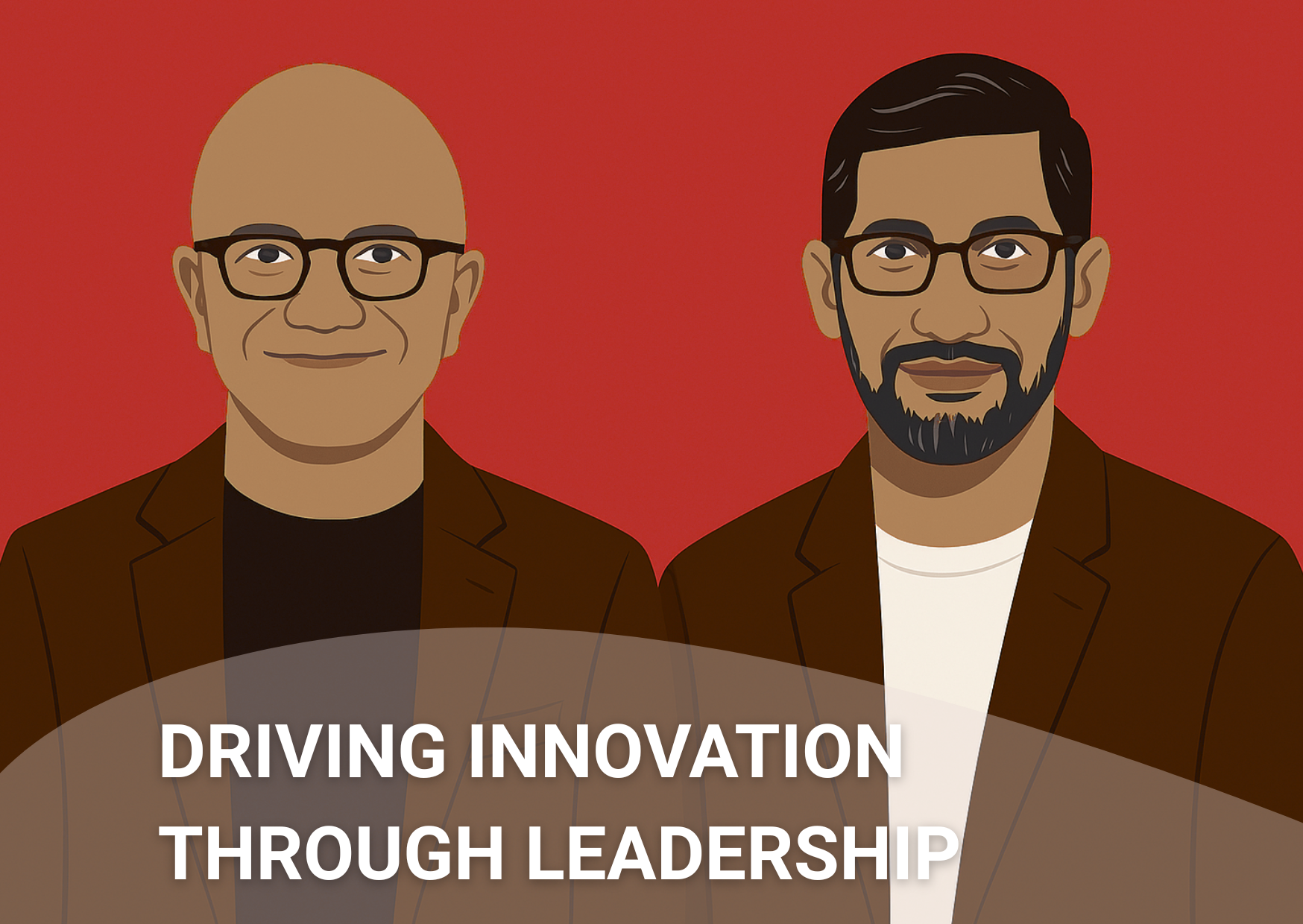
 In every era, organisations face a moment when doing more of the same is no longer enough. Innovation becomes the imperative, yet innovation is seldom a product of lone genius. It is nurtured by leadership that chooses curiosity over certainty, inclusion over ego, and long‑term bets over quarterly noise. Two leaders who exemplify this are Satya Nadella at Microsoft and Sundar Pichai at Google/Alphabet. Their approaches differ in tone and tempo, but both show how a CEO’s philosophy can unlock the kind of progress that transforms not just products, but the organisations that build them.
From stagnation to “learn‑it‑all”: Nadella’s cultural reset
When Nadella became Microsoft’s CEO in 2014, the company was wrestling with rigid internal silos, bruising politics, and a mindset that rewarded being right over learning. The shift he championed, from “know‑it‑all” to “learn‑it‑all” was both cultural and practical. It asked leaders to model curiosity, invite dissent, and treat experiments as sources of insight rather than career risk. That movement was chronicled in academic cases and leadership analyses, which emphasise the central role of growth mindset in reversing Microsoft’s slide into irrelevance.
Nadella’s reset was not a slogan. It came with mechanisms: leadership frameworks, hackathons, cross‑functional “One Microsoft” behaviours, and the dismantling of performance practices that encouraged internal competition over collaboration. By making empathy and learning explicit expectations, he legitimated exploration across the business - from open‑source engagement to rethinking the device‑centred strategy of the previous era.
The results were visible in the company’s strategic pivot. Microsoft doubled down on Azure; re‑established credibility with developers through GitHub and Linux friendliness; and placed bold bets on AI that now sit at the centre of its portfolio. A landmark, multi‑year expansion of the partnership with OpenAI - building frontier supercomputing on Azure and integrating models across products - underscored Microsoft’s intention to make AI a platform shift rather than an add‑on.
That wager matured through 2024 and beyond, as Microsoft’s shareholder letters and annual reports highlighted both commercial traction and the narrative: seize platform shifts, reinvent, and scale through cloud plus AI. Financial performance reinforced the story (cloud revenue, Copilot adoption, and sector‑wide customer outcomes), giving credence to the idea that culture and strategy were mutually reinforcing.
“AI‑first” with responsibility: Pichai’s long‑game
Sundar Pichai inherited a very different challenge. Google had abundant talent and research depth; the risk was complacency and fragmentation as scale grew. Pichai’s answer (declared as “AI‑first”) was to knit together the company’s scientific engine and product lines so AI could be applied end‑to‑end, from chip design and model training to consumer experiences and enterprise cloud. Interviews and leadership discussions trace this arc from early investments (Google Brain, DeepMind) to the consolidation of efforts into the Gemini era, with Pichai emphasising a full‑stack approach: infrastructure, models, and responsible deployment.
Crucially, Pichai has treated responsibility not as a communications add‑on but as governance and practice. Google’s published AI Principles (initially in 2018 and updated through annual Responsible AI Progress Reports) describe risk assessment, safety red‑teaming, model cards, and provenance tech like SynthID - all designed to test systems before scale and to embed ethics into development lifecycles. That posture has evolved under pressure, but the mechanism remains: review boards, frameworks, and transparency about capability and limits.
The sustainability dimension is also part of Pichai’s innovation thesis. Google’s public ambitions of net‑zero across operations and value chain by 2030, and 24/7 carbon‑free energy (CFE) for data centres, signal that scaling AI should be matched by climate discipline, even as the company acknowledges the complexity and trade‑offs involved in a world of rapidly rising compute demand. Recent reports detail both progress (new clean‑energy procurements, reductions in data‑centre emissions) and the challenges of supply‑chain scope and policy uncertainty.
Strategy is culture, and culture is strategy
Taken together, Nadella and Pichai demonstrate that innovation leadership is inseparable from organisational design. Nadella’s “learn‑it‑all” emphasis made it safe to pivot: sunset the mobile OS play, embrace open source, and place confidence in engineers to invent across platforms, not just Windows. The OpenAI partnership and Azure’s AI infrastructure were not isolated deals; they were the logical outcome of a firm taught to prioritise platform shifts and external collaboration over NIH (“not invented here”).
Pichai’s “AI‑first” stance likewise taught teams to think systemically. The move to a full‑stack posture - hardware (TPUs), research, foundation models, product UX - required coordination and patience. His public conversations highlight decision‑making that breaks stalemates without theatrics, empowering leaders to act while reinforcing the expectation that not all bets are permanent; iteration and course‑correction are part of the work.
Moonshots, grounded
Alphabet’s X lab has popularised the term moonshot: ambitious projects aimed at huge problems, powered by breakthrough technology, and tested ruthlessly to either spin out or shut down. Here, Pichai’s leadership connects to a portfolio mindset; supporting radical ideas whilst insisting on pathways to scale. The graduation of Loon (stratospheric balloons for connectivity) and Wing (drone delivery) into independent operations illustrates how Alphabet treats exploration as a legitimate route to value, even if the destination changes. Loon was wound down due to commercial challenges, however, some of its technology was migrated into other interests being developed with Alphabet’s support.
The significance is cultural: when organisations normalise audacity and discipline, they increase the odds that bold ideas survive beyond prototypes. Whether through X spinouts or product integrations, Google signals to engineers and product teams that the company will back long‑horizon work while measuring risk in the open.
Impact beyond headlines
For Microsoft, the impact of Nadella’s leadership is measured not only in market value but in renewed relevance: Azure’s ascent, the ubiquity of Microsoft 365 enhanced by Copilot, and the repositioning of the company as a partner in the AI economy. Shareholder letters describe a pattern, a reinvention at each platform shift, which suggests the cultural and strategic muscles built since 2014 are being applied again in the generative AI wave.
For Google, Pichai’s steady approach has kept the company competitive across search, cloud and consumer ecosystems, while building (and defending) processes for ethical AI. Public briefings and podcasts depict a leader comfortable with complexity: championing AI at scale, acknowledging its limits, and driving the organisation to make responsible choices in the face of intense market scrutiny.
Leadership lessons you can use
Lead with curiosity, not certainty. Nadella’s shift validated learning as a leadership behaviour. In practice, that means asking better questions, running disciplined experiments, and rewarding teams for insights - even when outcomes disappoint. It is the opposite of performative expertise.
Build full‑stack capability, but govern it. Pichai’s insistence on end‑to‑end AI capability works because it is matched by governance and safety tooling. For leaders outside big tech, the analogue is straightforward: invest in capability across the value chain, and invest equally in the policies, reviews and metrics that keep innovation trustworthy.
Treat sustainability as a design constraint. The future will be built by organisations that innovate within carbon, water and resource boundaries. Google’s CFE roadmap and disclosures remind us: growth must be architected alongside climate responsibility, even when the trade‑offs are hard.
Normalise moonshots, but be honest. Boldness without intellectual honesty becomes waste. The X model demonstrates that audacity and kill‑criteria must coexist; leaders should fund exploration, then test ruthlessly and spin out or shut down with clarity.
Decide, then iterate. Pichai’s public reflections emphasise breaking ties, avoiding analysis paralysis, and recognising that most decisions are reversible. Innovation requires momentum; leadership provides it.
Final thought
Innovation is ultimately a human system: the stories we tell, the permission we grant, and the choices we make when the future is uncertain. Satya Nadella shows what happens when a leader rewrites a company’s internal script to favour empathy and learning. Sundar Pichai shows what happens when a leader orchestrates scale - technical, ethical, and environmental - without surrendering patience or prudence. For any organisation wondering how to drive genuine innovation, the lesson is simple: build cultures that learn, govern, and decide. The breakthroughs will follow.
Want to know more about how we can support your organisation's leaders to drive innovation? We would love the opportunity to explore this with you. Simply contact us using this 👉 link


 Chat with us via Whatsapp